San Bernardo Islands from Cartagena: Private Boat Tour Guide [2026]
10 coral islands, the world’s most densely populated island, and reef visibility up to 20 meters — a full day charter from Cartagena starting at $1,360.
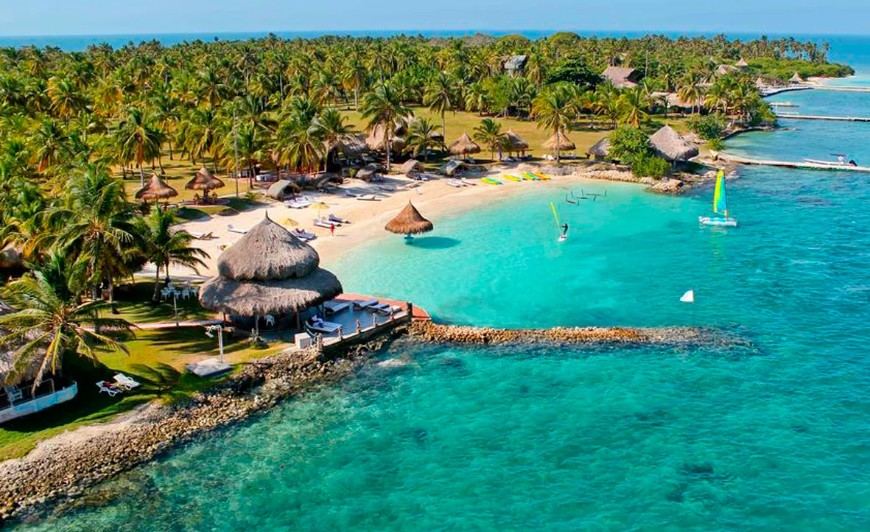
Most travelers who visit Cartagena go to the Rosario Islands. Some go to Barú and Playa Blanca. Very few — even experienced Caribbean travelers — make it to the San Bernardo Islands. That ratio is about to change, and if you are reading this guide, you are ahead of the curve.
The San Bernardo Islands sit 90–120 km south of Cartagena, roughly twice the distance of the Rosario Islands. That extra distance means 1.5–2 hours by private speedboat instead of 45–60 minutes — and it means the archipelago receives a fraction of the boat traffic that the Rosario Islands absorb daily. The result is some of the most unspoiled beaches in the Colombian Caribbean, coral reefs in noticeably better health, and a day on the water that feels genuinely different from anything you can do closer to the city.
What Are the San Bernardo Islands?
The Islas de San Bernardo is an archipelago of 10 coral islands in the Colombian Caribbean, located off the coast of Tolú and Coveñas (department of Sucre), approximately 90–120 km south of Cartagena. The islands are part of Parque Nacional Natural Corales del Rosario y San Bernardo — the same national park that protects the Rosario Islands, but a geographically separate and far less commercially developed sector of it.
The water temperature sits between 27–29°C year-round. Underwater visibility in good conditions reaches 10–20 meters, consistently higher than at the Rosario Islands, where the heavier boat traffic has reduced clarity over time. The coral systems at San Bernardo include brain coral, staghorn, and plate coral formations that marine biologists have documented as among the best-preserved in the Western Caribbean at this latitude.
The four islands that receive visitors are: Santa Cruz del Islote (the densely populated settlement), Tintípan (the largest island, long beaches, local fishing communities), Múcura (home to boutique hotel Punta Faro), and Palma (small, pristine, very few visitors). The remaining six islands in the archipelago are uninhabited.
The key differentiator — and this is the honest logistical reality — is that while the Rosario Islands receive hundreds of boats daily from Cartagena’s public ferry system, San Bernardo’s tourist market has not been masified. The operators who run there are smaller, the infrastructure is minimal, and in low season you can have entire beaches to yourself. The distance is not a problem; it is the protection mechanism.
How to Get to the San Bernardo Islands from Cartagena
Private Speedboat Charter (Recommended) — From $1,360
A private speedboat charter from Marina Manga or La Bodeguita in Cartagena is the only practical option for a day trip. The journey takes 1.5–2 hours at cruising speed. Your charter includes the captain (DIMAR-certified), fuel for the full round trip, and a cooler with ice. The itinerary is completely flexible — you decide which islands to visit, how long to stay at each stop, and when to head back.
For a group of 10 people, $1,360 total = $136 per person. That is comparable to, or less than, many group tours to the Rosario Islands — for a destination that almost no one else in the water around you has been to. There is no public group tour industry running day trips from Cartagena to San Bernardo. The people who get there go by private boat.
Nauty 360 recommends departing at 6:30–7:00am. This gives you 5–6 productive hours at the islands before the 1.5–2h return, arriving back in Cartagena by late afternoon. An early start also means the first two hours of navigation happen in the calmest sea conditions of the day. For all Cartagena charter options and vessel availability, the full fleet listing has current pricing and capacity per boat.
| Vessel | Capacity | Price | Best for |
|---|---|---|---|
| Lancha (speedboat) | Up to 8 pax | From $1,360 | Couples, small groups |
| Lancha Grande | 10–12 pax | From $2,500 | Families, medium groups |
| Catamaran | Up to 30 pax | From $4,640 | Large groups, corporate events |
All prices for round trip from Cartagena. Include DIMAR-certified captain, fuel, life jackets, and cooler with ice.
Bus + Local Lancha from Tolú (Budget Route)
There is a land-and-sea route that budget travelers use, but it is not viable for a day trip from Cartagena. The route goes: bus from Cartagena to Tolú or Coveñas (3–4 hours, roughly $15,000–25,000 COP), then a local lancha from Tolú’s pier to the islands (45 minutes, ~$15,000–25,000 COP per person). One-way transit time from Cartagena: 4–5 hours minimum.
This route makes sense only if you are already staying in Tolú or Coveñas, or if you are planning an overnight stay at Hotel Punta Faro on Múcura. For a day trip from Cartagena, the combined travel time leaves almost no time at the islands.
| Transport | Departure point | Duration to islands | Return flexibility | Cost (10 pax) |
|---|---|---|---|---|
| Private charter from Cartagena | Marina Manga / La Bodeguita | 1.5–2h | Full flexibility | From $1,360 total |
| Bus + local lancha from Tolú | Cartagena bus terminal | 4.5–5.5h | Fixed schedules | ~$30–50 per person |
What to Do at the San Bernardo Islands
Santa Cruz del Islote — The World’s Most Densely Populated Island
Santa Cruz del Islote is an outlier in the history of human settlement. Over 1,200 people live on an island smaller than 0.1 km² — a population density higher than Manhattan, higher than Dhabi, higher than any island settlement on record. There are no cars (there is no road wide enough). There is no cemetery — the island has no room for one; the dead are taken by boat to be buried on a neighboring island. The community has been here for generations, sustained by fishing and, in recent decades, the modest tourism that comes by private boat.
A visit of 30–45 minutes is enough to walk the island end to end (it takes about 4 minutes), talk to vendors selling fresh coconut or handmade crafts, and understand viscerally what 1,200 people on a fraction of a city block actually looks and feels like. Bring cash in Colombian pesos — the income from tourist visits matters to the community, and buying something from the local vendors is the appropriate way to visit a place that has none of the commercial infrastructure of the Rosario Islands.
One insider note from captains who run this route regularly: Sunday mornings are when the island is most alive — there is a weekly church service, and the community gathers in the small central square. If your group is curious about the cultural dimension of the visit rather than just ticking off a geographic curiosity, a Sunday departure is worth planning.
Snorkeling at the Coral Reefs
The coral reefs at San Bernardo are in measurably better condition than those at the Rosario Islands, for a simple reason: far fewer boats pass over them. Lower anchor drop frequency, less sunscreen and fuel runoff from tourist traffic, and less physical contact from swimmers have allowed the reef structures to remain intact in areas that comparable reefs near Cartagena lost years ago. Visibility runs 10–15 meters on typical days and can reach 20 meters during the dry season (December–April) when runoff from land is minimal.
Common sightings include tropical reef fish (parrotfish, angelfish, wrasse), small rays resting on sandy bottoms, sea urchins, and occasional hawksbill sea turtles. Your captain will know the specific anchoring points that maximize reef quality — the best spots are not directly at the inhabited islands but at submerged reef structures between them. For a full comparison of all snorkel and beach options near Cartagena, the beach guide covers conditions month by month.
Tintípan Island — The Longest Beach
Tintípan is the largest island in the San Bernardo archipelago. Its beaches stretch for several hundred meters of fine white sand without the vendor density or crowd levels that characterize Playa Blanca at Barú on a weekend. There are a handful of small restaurants operated by local fishing families — fresh fish, fried plantain, coconut rice — all priced in Colombian pesos at levels that will surprise anyone used to tourist-zone pricing in Cartagena’s Bocagrande.
Tintípan is where most private charters spend the longest portion of the day. The combination of beach quality, food options, and the sense of having arrived somewhere genuinely off the main tourist circuit makes it the natural anchor point of a San Bernardo day. If your group wants to spend four hours at a single beach with zero crowds, Tintípan is the destination.
Múcura Island — Luxury in the Middle of Nowhere
Hotel Punta Faro dominates Múcura. The boutique property has been operating for decades and is one of the few examples of genuinely sustainable luxury in the Colombian Caribbean — solar-powered, staff recruited from local fishing communities, ingredients sourced from the sea and nearby mainland farms. The restaurant is considered one of the best in coastal Colombia by food writers who have made the trip specifically to eat there.
External visitors (non-guests) can dine at Punta Faro’s restaurant with advance reservation. Lunch runs approximately $40–80 per person depending on what you order. If your charter group has the budget and one member is a serious food traveler, this is worth building into the itinerary — it is the kind of meal in the kind of setting that takes actual effort to access, and that effort is the point.
Palma Island — The Quiet One
Palma is the smallest and least visited of the four accessible islands. There is no permanent settlement, no restaurant, no vendor. There is white sand, palm trees, and the kind of Caribbean water that looks like the stock photo that inspired the stock photo. Groups who want 2–3 hours of genuine solitude in the Caribbean — not a beach with fewer people, but a beach with no one else — should put Palma on the itinerary. Your captain anchors close to shore; the island is accessible by wading.
San Bernardo Islands vs. Rosario Islands — Which Should You Choose?
The two archipelagos operate within the same national park but serve different traveler profiles. Here is the direct comparison across the factors that matter most for planning a day charter from Cartagena. For a deeper dive on the Rosario Islands specifically, the complete Rosario Islands guide covers every island and stop in detail.
| Factor | San Bernardo Islands | Rosario Islands |
|---|---|---|
| Distance from Cartagena | 90–120 km (1.5–2h) | 35–45 km (45–60 min) |
| Crowd level | Very low | Medium–high |
| Coral health | Excellent (less boat traffic) | Good (heavier traffic) |
| Beach quality | Pristine, uncrowded | Beautiful but busier |
| Unique attraction | Santa Cruz del Islote | Cholón beach clubs |
| Practical via public transport? | No (distance) | Yes (colectivo ferry) |
| Best for | Return visitors, exclusivity seekers | First-time visitors, large groups |
| Private charter from | $1,360 | $680 |
The honest summary: go to the Rosario Islands first if this is your first time in Cartagena. Cholón, Isla Grande’s reef, and the Natural Aquarium make a genuinely great day that works for almost any group. Come back to San Bernardo when you want to go further and find something that most Cartagena visitors will never see. For the full side-by-side breakdown of the two closest options to Cartagena, see our Rosario Islands vs Barú comparison guide. Before your first visit, our guide on is Cartagena safe to visit in 2026 answers the most common questions from first-time visitors to the city.
Why a Private Boat Is Essentially Required
The logistical reality of San Bernardo is straightforward: there is no organized public transport or group tour industry running day trips from Cartagena to these islands. The distance makes colectivo-style tours economically unviable for operators who need to fill 40–80 seats to break even on fuel. What that means for you is that the San Bernardo Islands remain one of the few Caribbean destinations near a major city where the barrier to entry is logistics rather than price.
A private charter from Cartagena starting at $1,360 solves the logistics entirely. For a group of 6–10 people, the per-person cost lands between $68–$113 — comparable to or less than a premium group tour to the Rosario Islands, with a boat and itinerary that belongs entirely to your group. You leave when you want, stop where you want, and stay as long as the sea conditions and your captain’s judgment allow. For a full overview of all charter formats available from Cartagena, the Cartagena boat tour guide has the complete breakdown by boat size, duration, and destination.
Private boat from Cartagena to the San Bernardo Islands from $1,360 — DIMAR-certified captain, fuel for the full round trip, and a cooler with ice included. Up to 10 passengers. Confirmation in 2 hours.
Chat on WhatsApp — Get a Cartagena QuoteBest Time to Visit the San Bernardo Islands
Because the journey from Cartagena is 1.5–2 hours on open water, sea conditions matter more here than on shorter routes to the Rosario Islands. The Colombian Caribbean has two distinct seasonal patterns that affect both comfort and safety on the crossing.
| Season | Conditions | Recommendation |
|---|---|---|
| December – April | Dry season. Calm seas, best underwater visibility, minimal rainfall. Peak January–March. | Best overall. Book early for December and Semana Santa. |
| May – June | Transition to rainy season. Occasional afternoon showers, fewer tourists. | Excellent value. Conditions still good, crowds low. |
| July – August | Summer peak. Warm, generally good sea conditions. | Good. Book at least 2 weeks ahead. |
| September – October | Rainy season peak. Higher swells possible, stronger winds. | Not recommended for the San Bernardo crossing specifically. Consider Rosario Islands instead. |
| November | Transition. Improving conditions. | Acceptable from mid-November onward. |
Nauty 360 captains monitor swell forecasts (specifically significant wave height on the 90–120 km open-water segment) before confirming San Bernardo departures. When conditions are borderline — swells above 1.5 meters are uncomfortable on a speedboat for 2 hours — the team will proactively suggest rescheduling or redirecting to the Rosario Islands. The safety protocol is the same one applied to all offshore routes. No departure happens without a captain sign-off on conditions.
Planning Your Full Day at San Bernardo Islands
A well-structured day at San Bernardo from Cartagena runs approximately 11 hours dock to dock. The itinerary below is a template — your captain will adjust based on sea conditions, group preferences, and which stops take longer than expected.
- 6:30am — Departure from Marina Manga or La Bodeguita, Cartagena. Non-negotiable early start for a day trip of this distance.
- 8:00–8:30am — Arrive at Santa Cruz del Islote. Visit the settlement (30–45 min). Buy something from local vendors.
- 9:15am — Reef snorkel stop. Captain selects the best anchor point based on conditions (1–1.5h).
- 11:00am — Arrive Tintípan Island. Main beach stop. Lunch at a local restaurant or catering brought on board (2–3h).
- 2:00–2:30pm — Optional: Palma Island (quiet solitude, 45 min) or Múcura / Punta Faro (with lunch reservation, 1.5h).
- 3:30–4:00pm — Begin return to Cartagena.
- 5:00–5:30pm — Arrive back at dock.
Groups with children under 8 should note that the 1.5–2h boat ride each way on open Caribbean water is the most taxing part of the day for young passengers. If the group includes young children, discuss this with your captain when booking — vessel selection matters (a larger, more stable boat is significantly more comfortable on the open-water segments).
Frequently Asked Questions
Related Guides